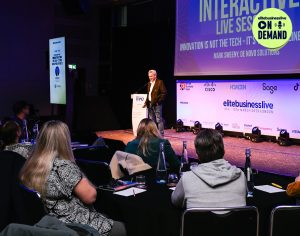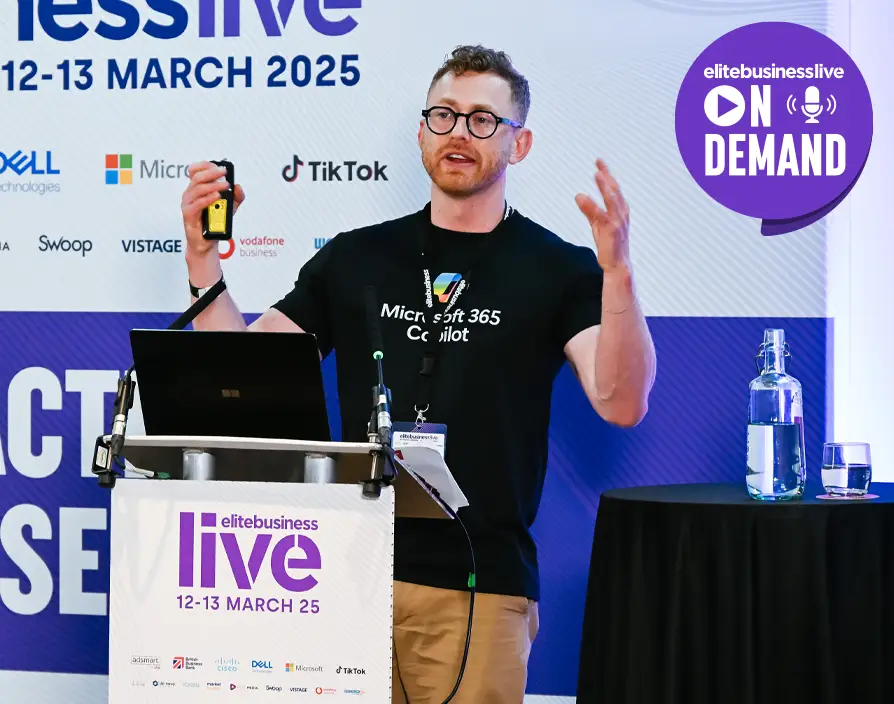
At Elite Business Live 2025, Tom Batcheler, Worldwide Director for Modern Work at Microsoft and global lead for Microsoft 365 Copilot in SMB, delivered a standout session that struck the perfect balance between visionary and practical. With clarity, humour, and genuine excitement, Tom walked us through the rapidly changing landscape of artificial intelligence, not in the abstract, but in the trenches of everyday business.
And what struck us most? AI isn’t tomorrow’s technology. It’s today’s competitive advantage.
AI is already here, and your employees know it
“79% of employees are already using AI at work,” Tom told the room, citing Microsoft’s internal data. “They’re going to ChatGPT, Claude, Bard and using whatever tools they find useful. But only 61% of companies have an actual AI strategy in place.”
It’s a reality many of the audience recognised with a sheepish nod. Staff are experimenting. Data is flowing. Policies are… patchy. That’s a risk, Tom warned, but also a huge opportunity.
“Even if your strategy is to block AI for now, you still need a strategy,” he emphasised. “Because the biggest risk isn’t that your competitors adopt it. It’s what your own people do without guidance or guardrails.”
Why AI needs to be more than a buzzword
Tom didn’t waste time on hype. Instead, he focused on tangible results:
- A 353% ROI over three years (even with conservative estimates)
- A 6% increase in net revenue
- A 20% drop in operating costs
- And most interestingly, a 60% rise in employee satisfaction
That last figure felt especially real. “We’re seeing new recruits ask whether they’ll have access to AI tools before they accept a job,” Tom shared. “That’s how quickly expectations are shifting.”
Enter copilot
Microsoft 365 Copilot isn’t about replacing your people with robots but instead giving them a ridiculously powerful assistant. In a live demo, Tom asked Copilot to summarise a meeting he’d missed and instantly got a structured recap. He followed up by asking it to generate a six-month marketing campaign, complete with quirky launch ideas, a workback schedule, and assigned roles, all grounded in real company data.
“This isn’t just search,” he said. “It’s reasoning. It knows your files, your meetings, your projects, and it makes smart suggestions based on that context.”
It’s also secure. Microsoft’s Copilot creates unique agents per user, applies data permissions dynamically, and never uses your data to train external models. In short, it’s built for business.
The real magic? AI agents
One of the most forward-looking (and frankly jaw-dropping) parts of the session was about Copilot Agents. Customisable virtual teammates that can complete tasks, access specific data sources, and act semi-autonomously.
Tom broke them down into three levels:
- Retrieval agents – Fetch info from internal systems (e.g. “How do I reset my password?”)
- Task agents – Execute actions (e.g. open an IT ticket)
- Autonomous agents – Handle ongoing workflows and even collaborate with other agents
“You could build a finance agent that always responds in table format and knows what data it’s allowed to access,” he explained. “Or a support agent that escalates complex queries automatically. You can train it in minutes with no coding experience needed.”
Copilot in action
Tom shared stories from businesses already using Copilot to reshape operations:
- Burke, a data consultancy, halved analysis time by using Copilot to transcribe meetings and generate structured discussion guides.
- Unifonic, a professional services firm, analysed conversation sentiment across transcripts to proactively flag issues.
- Leviatan Design, a construction company, now uses Copilot to automate quote comparisons and streamline supplier evaluations.
Each story shared a single theme: Copilot isn’t about replacing people. It’s about freeing them up to do what they’re great at.
Culture comes first
What became increasingly clear is that leadership buy-in is critical. Tom was later joined onstage by Luke Alexander from Four Agency, who echoed that sentiment: “We have board time dedicated to AI every month. Our CEO uses Copilot and talks about it openly. That normalises adoption across the business.”
Luke shared how Four has saved between 15,000 and 18,000 hours per year since integrating Copilot, time previously spent on admin, not strategy. “It’s not just productivity,” he said. “It’s staff retention. It’s creativity. It’s capability.”
And most memorably: “We used to lose great people. Now they stay because they’re doing more meaningful work.”
Your next step starts with a question
Tom wrapped with a simple framework for getting started:
- Are your leaders modelling AI adoption?
- Do you know which workflows would benefit most?
- Are your employees asking for tools they don’t yet have?
- Do you have a culture of experimentation?
He left the Elite Business Live audience with one of the most important message of the day:
“AI is already in your business, whether you know it or not. The only question is whether you’re harnessing it in a way that’s secure, strategic and future-ready.”
Share via: