Technology has never been more accessible.
Artificial intelligence, cloud platforms and automation tools promise to transform the way businesses operate. Every week brings another breakthrough, another software release or another bold prediction about the future of work.
But according to Mark Sweeny, Founder and Chief Executive of De Novo Solutions, most businesses are asking the wrong question.
The challenge isn’t whether you have the latest technology. It’s whether your organisation has the discipline to use it.
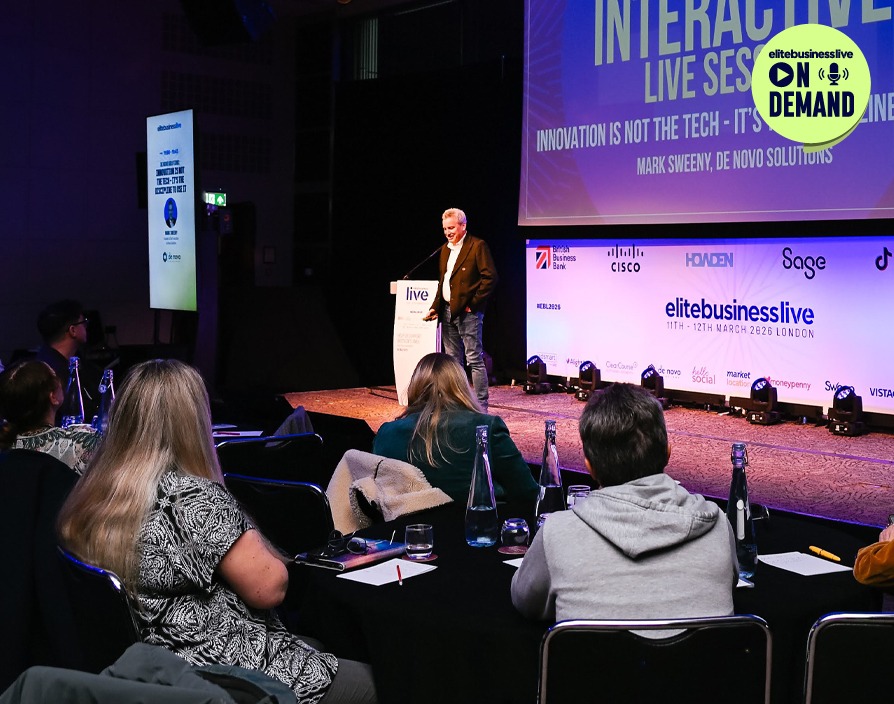
Speaking during an Interactive Live Session at Elite Business Live 2026, Sweeny challenged one of the biggest misconceptions surrounding innovation today. Drawing on De Novo’s own journey from start-up to a £12 million technology business in under four years, he argued that sustainable growth has far less to do with software than most leaders believe.
Instead, innovation is built on consistent habits, operational discipline and a relentless focus on execution.
Technology only amplifies what already exists
For many businesses, innovation begins with buying new technology.
- A new CRM
- A new AI platform
- A digital transformation project
Sweeny believes that’s where many organisations go wrong. “If you don’t use it, if you don’t embed it into your organisation, the tech just amplifies it.” That amplification works both ways.
Businesses with strong processes become more productive. Businesses with inconsistent ways of working simply become inconsistent at a greater speed.
As Sweeny explained, technology acts like a spotlight, exposing weaknesses that already exist within an organisation. “If you’re disciplined, it will make you more productive. If you’re chaotic… it amplifies the chaos.”
It’s a refreshing perspective in an era dominated by conversations about AI. Technology isn’t the competitive advantage. How people use it is.
Innovation starts in the back office
One of the session’s most thought-provoking messages was that innovation rarely begins where customers can see it.
Businesses often focus on improving sales, marketing or customer experience, while overlooking the operational systems supporting those activities. Sweeny argued that this is backwards.
- Finance
- Payroll
- HR
- Operations
- Knowledge management
These may not feel particularly exciting, but they provide the foundation for sustainable growth. “Back office innovation enables the front office innovation, but it only works if you use the tools.” As organisations grow, complexity grows with them.
Without clear systems and consistent processes, costs increase, margins tighten and service quality begins to suffer.
Innovation, therefore, isn’t simply about introducing better software. It’s about building an organisation capable of using that software effectively every single day.
Why the traditional professional services model is under pressure
Drawing on De Novo’s own experience, Sweeny explored one of the biggest challenges facing professional services firms.
For decades, growth has largely depended on adding more people.
- More consultants
- More billable hours
- More revenue
The problem is that the model eventually reaches its limits.
“You can’t be the traditional ‘bums on seats’ model. You need to break out of that.”
As AI becomes more capable, those structural limitations are becoming increasingly obvious.
Businesses built entirely around selling time will find it harder to compete.
Instead, Sweeny encouraged founders to think differently about how they create value.
At De Novo, that has meant:
- Packaging intellectual property into repeatable solutions.
- Building recurring revenue through managed services.
- Developing long-term customer relationships.
- Creating AI-enabled business services.
- Focusing on outcomes rather than hours worked.
It’s a shift from selling effort to delivering expertise at scale. For many service businesses, that represents a significant change in mindset.
Discipline beats motivation every time
If there was one word repeated throughout the session more than any other, it was discipline.
Sweeny described innovation not as a one-off initiative, but as an operating system embedded throughout the business. “The most important words are rigour and discipline.” Technology may generate insights.
AI may perform analysis. Dashboards may highlight trends. But none of those things creates results unless leaders consistently act on the information available to them.
That means establishing routines that become part of everyday business life.
At De Novo, that includes:
- Daily cash flow reviews.
- Weekly sales and delivery meetings.
- Continuous financial monitoring.
- Regular operational analysis.
- Consistent use of business systems.
Rather than relying on monthly reports or quarterly reviews, decision-making becomes continuous.
Sweeny described this as creating the right cadence. Because businesses don’t scale through occasional moments of brilliance. They scale through consistent execution.
Great businesses build systems that outlast people
Another key insight centred on organisational knowledge.
Many growing businesses unknowingly store critical expertise inside the heads of individual employees. When those people leave, valuable knowledge disappears with them.
Sweeny believes businesses should instead capture that knowledge within their operating systems. “People will come and go from your business over time. But you will need to retain the corporate knowledge.”
- Processes
- Workflows
- Playbooks
Decision-making frameworks.
These become assets that continue creating value regardless of who joins or leaves the organisation.
It’s another reminder that innovation is as much about organisational design as it is about technology.
Operational excellence is becoming a competitive advantage
Towards the end of the session, Sweeny returned to the broader message underpinning the entire discussion.
Operational innovation isn’t a project. It’s a leadership responsibility. “Operational innovation… that’s the leadership discipline.” As businesses become larger and more complex, those disciplines become even more important.
- Cash flow forecasting
- Scenario planning
- Risk management
- Investment decisions
- Customer delivery
- These aren’t glamorous topics
But together, they create resilient organisations capable of adapting to change.
Technology simply helps accelerate the process.
Final thoughts
For all the discussion around AI, automation and digital transformation, Mark Sweeny’s message was remarkably simple.
Innovation isn’t about chasing every new technology. It’s about creating a business that is disciplined enough to benefit from it.
The companies that thrive over the next decade won’t necessarily be those with the biggest technology budgets.
They’ll be the organisations with the strongest operating systems.
The clearest routines. The most consistent behaviours. And the discipline to execute them every single day.
For founders and business leaders, that’s an encouraging thought.
Because while technology continues to evolve at an extraordinary pace, discipline remains entirely within our control.
As Sweeny’s own journey with De Novo demonstrates, that may prove to be the most valuable innovation of all.
Share via: