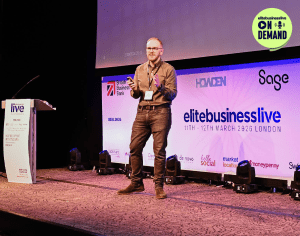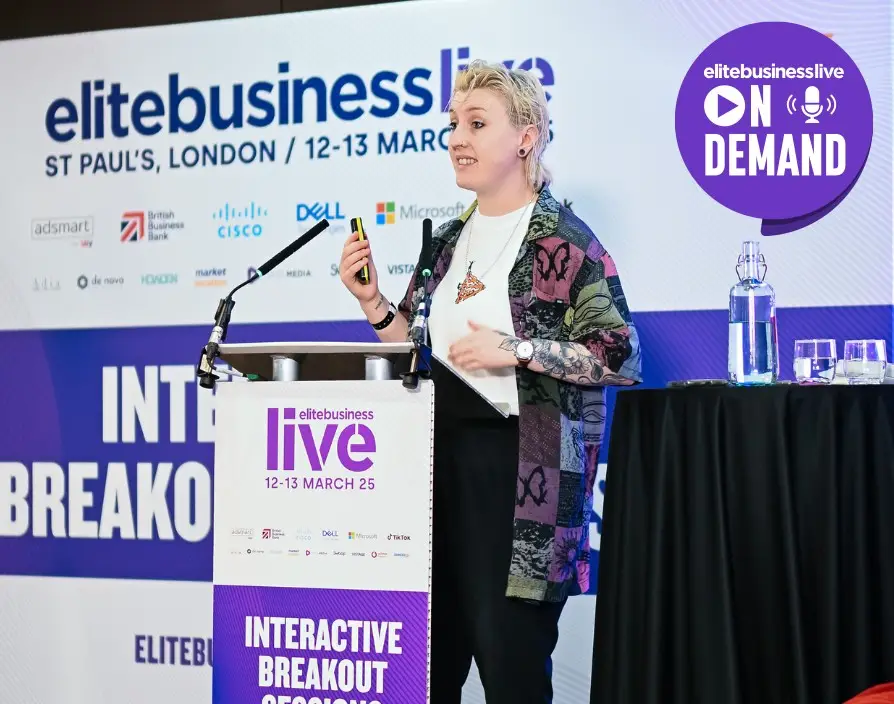
You know a session’s going to be something special when, within minutes, the speaker is talking about rebellious creativity, jumping out of planes, and calling for more tattoos in boardrooms. Chloe Clover, CEO and Co-Founder of Wander, isn’t just a creative leader. She’s a force. And at this year’s Elite Business Live, she gave us a masterclass in something many businesses think they have, but so few actually do: a real, beating-heart brand personality.
What followed was one of the most energising, vulnerable, and ultimately empowering sessions of the event.
“Brand personality is everything.”
Chloe started not with a corporate case study but with a story. Her story. From dropping out of school at 15 to discovering her creative spark through film, art, and eventually a global backpacking adventure with her now-business partner Lou, Chloe showed us how the roots of Wander are entwined with emotion, rebellion, and purpose.
And this, she said, is exactly the point.
“Brands forget to be human,” she told us. “But people buy from people. And brand personality is what makes that connection real.”
As the slides clicked on behind her, Chloe outlined the fundamental truth of modern marketing: consumers don’t fall in love with products. They fall in love with how those products make them feel.
From human to brand and back again
Alongside team member Caitlin, who held the room with quiet confidence and a killer Lego slide. Clover drew parallels between individual and brand personality.
“Think of your brand as a person,” Chloe’s colleague at Wander, Caitlin urged. “What would they be like? Fun? Ambitious? Cheeky? Empathetic? Your brand traits should be recognisable across every touchpoint. Whether you’re posting on LinkedIn, chatting in a sales call, or creating a TV ad.”
To illustrate the point, the audience was invited to play a logo-free game of brand identity bingo. Even stripped of their names, everyone instantly recognised Nike, Lego, and Surreal. Why? Their tone, style, and values ooze from every image, word, and colour choice. These brands don’t just market, they embody.
Personality builds trust and differentiation
As Chloe put it, “Brand personality is what humanises your business. It builds an emotional connection. And in a crowded marketplace, it’s your most powerful point of difference.”
But this wasn’t just feel-good fluff. Clover broke it down into tangible frameworks:
- Voice – How does your brand sound? Casual? Inspirational? Provocative?
- Values – What does your brand stand for?
- Visual identity – Are your images and colours in tune with your character?
- Messaging – What stories are you telling, and how are you telling them?
She even revealed Wander’s internal IP, a brand framework pyramid that begins with purpose, climbs through ambition and proposition, and is underpinned by values and personality traits. It was part therapy session, part marketing strategy and 100% applicable to any business in the room.
“You can’t out-robot the robots.”
There was a moment, perhaps the audience’s favourite, where Chloe addressed the creeping spectre of AI. While acknowledging its power for streamlining, she made a sharp point:
“AI can’t replicate emotion. It doesn’t have lived experience. It doesn’t feel shame or joy or heartbreak. Your personality and your human perspective are your biggest competitive edge. It’s what makes you not a robot.”
It was a reminder that in an increasingly automated world, our flaws, quirks and inconsistencies aren’t weaknesses. They’re superpowers.
Key takeaways from Wander’s brand playbook
This was no dry lecture. In between powerful insights, Caitlin returned for rounds of games and audience interaction, decoding Gen Z vs. Gen X behaviour and using Pokémon as an analogy for audience segmentation. (Yes, really. And it worked.)
Key takeaways:
- Know your audience – Build out rich personas and meet them where they are.
- Define your brand values – Choose three to five that reflect your ethos and your mission.
- Be consistent – From TikTok to tube ads, stay recognisable in tone and message.
- Use storytelling – People connect with journeys, not sales pitches.
- Adapt, but don’t lose yourself – Evolve with your audience without diluting your core identity.
A final word on authenticity
One of the final questions from the audience came from a business owner grappling with whether being inauthentic on social media for years had damaged their brand. Chloe’s response was beautiful:
“You haven’t damaged your brand. You’ve evolved. The most powerful thing you can do is be unapologetically yourself. That’s how you build real connections. And that’s how you grow.”
By the end of the session, the entire room felt more human, more inspired, and ready to return to their brands with bolder voices and clearer minds.
Share via: