Most organisations have spent the past few years trying to get tools in place, run pilots, and establish use cases. Teams have tested copilots, explored LLMs, automated fragments of delivery processes, and found small but promising areas of efficiency. In many cases, adoption isn’t the sticking point. The issue is what AI finds once it arrives.
AI doesn’t land in a vacuum. It arrives into workflows that are already there, when systems are configured and habits formed. If the environment is clear, connected, and aligned, the potential is real. But if it’s fragmented or outdated, the most likely outcome is added complexity. And when work becomes harder to follow, people drift away from the process and eventually, away from the tool itself.
monday.com’s ‘World of Work’ research shows UK employees are very willing to adopt AI. Three quarters of respondents are keen to use it, but over half (52%) call for better training to help manage changes. A significant majority (88%) believe better strategies around AI integration are key to doing their best work. This data shows that people are ready to move – if they’re given the right tools and the right environment.
The real unlock with AI isn’t just adoption. It’s shaping the environment it lands in.
AI environments matter as much as the model
One of the most common misconceptions is that AI will automatically make teams more efficient. Many companies assume that once they’ve chosen the right AI platform, progress will follow. But in practice, new tools often land on top of legacy structures and outdated behaviours.
The risk in the current landscape is that AI becomes another layer of abstraction in organisations already dealing with too much noise. There’s a danger that, in the rush to deploy, teams bypass the important work of improving the environment. And when that happens, the gap between what AI could deliver and what it actually achieves will only widen. Models will improve. Tools will get better. But the benefits will often remain uneven – because the structures can’t absorb the change.
None of this is a reason to slow down. But it is a reason to focus. If we want AI to contribute meaningfully to delivery – not just to experimentation – we need to build environments that are fit for the systems we’re trying to create. That means reducing coordination overhead. It means aligning the shape of work with the way it gets measured. It means fixing the basics: visibility, ownership, and flow.
Most resistance isn’t resistance
Viewed through the right lens, barriers can become moments of strategic opportunity. Take the uncertainty that surrounds the introduction of AI in the workplace – concerns about job security, changing workflows, and the unknown of working alongside intelligent systems. Most of the time, when teams hesitate, it’s not because they’re anti-AI. It’s because the context isn’t giving them enough: no clarity on impact, or a lack of real conversation about how the tool fits into what they already do.
Organisations that will roll AI out successfully are those that pounce on the opportunity that such hesitation brings. Not just by introducing comms or coaching decks, but with practical changes: better visibility, clearer scope, tighter alignment between the system and the work it’s meant to support. Training matters – but not in isolation. What people need is a clear sense of how these systems behave in context. Who owns the output. What’s still manual. What’s been automated. Where discretion still matters. When teams have that context, change looks and feels different. People are quicker to experiment because they know the edges of the system. Feedback gets sharper.
The cost of falling behind
In today’s fast-moving market, hesitating on AI isn’t neutral – it will likely carry some form of cost. For example, delayed adoption can lead to siloed teams, fragmented workflows, and missed opportunities to innovate. And while some businesses are still calculating the initial impact of AI, others are already exploring the “how much further” – and continuing to see the tangible benefits of that.
As already discussed, that’s not to say all AI implementation is created equal. When disconnected from real employee needs, AI can create confusion. But when done right – with clear strategy and user-friendly tools – it becomes a powerful accelerator for productivity, creativity, and innovation.
The real value of AI is in its ability to amplify what people do best. Automating repetitive admin tasks frees up employees time to focus on strategic, high-impact work. And at monday.com, we focus on integrating AI into the platform in a way that feels natural, enabling teams to make faster decisions, automate processes, and gain strategic insights without disrupting workflows or adding complexity.
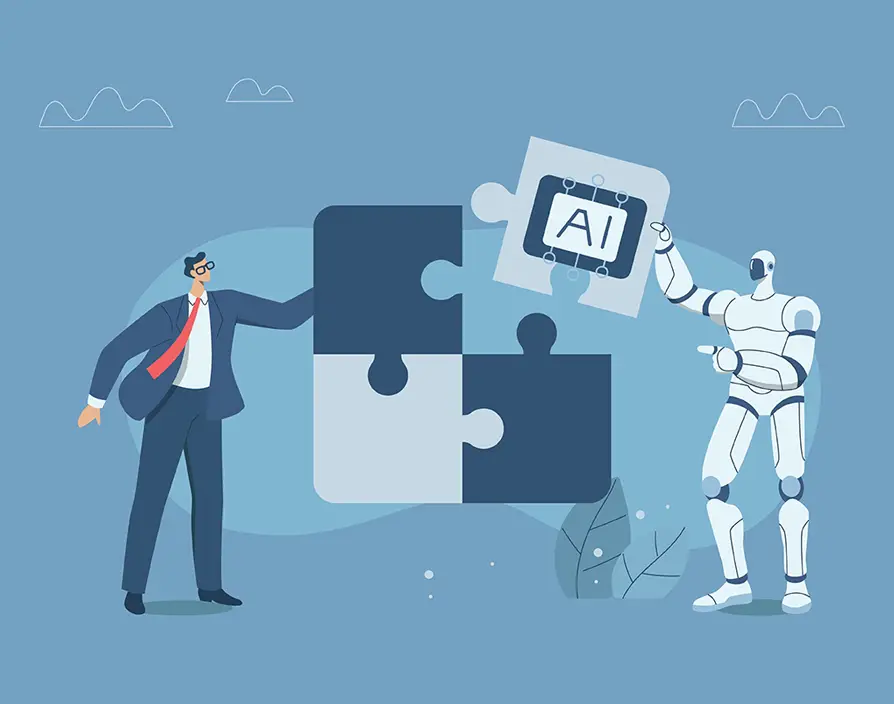
Without this shift, organisations risk underutilising talent. When disconnected from tools meant to support them, morale can suffer. Those that implement AI effectively, on the other hand, can respond quickly to market changes and create environments where employees are empowered to do their best work. And the key to broader success? Position AI as a collaborator rather than a competitor.
Laying the foundations for AI integration
Successful adoption starts with making AI accessible, collaborative, and people-focused. This means prioritising user-friendly solutions. Not every employee needs to be an expert to contribute to AI-driven growth. Platforms with intuitive interfaces and simplified processes can bridge skill gaps – allowing teams to experiment. Low-code or no-code AI tools make it possible for non-technical staff to participate in digital transformation, helping to democratise innovation across the organisation.
Collaboration is equally essential. AI integration should not happen in a vacuum or be confined to technical or IT departments. Encouraging cross-functional teams to co-create solutions and bring diverse perspectives to the table can break down silos. At the same time, it helps teams to understand and embrace the changes AI brings into their daily work. And that range matters – 72% of UK employees want to feel a greater sense of ownership in their company’s direction.
We don’t need more proof that AI can help. We need to make it easier for people to tell when it is. That means making sure the surrounding environment – the workflows, the ownership, the culture – actually lets the tool land. When the system makes sense, people benefit from it.
Share via: