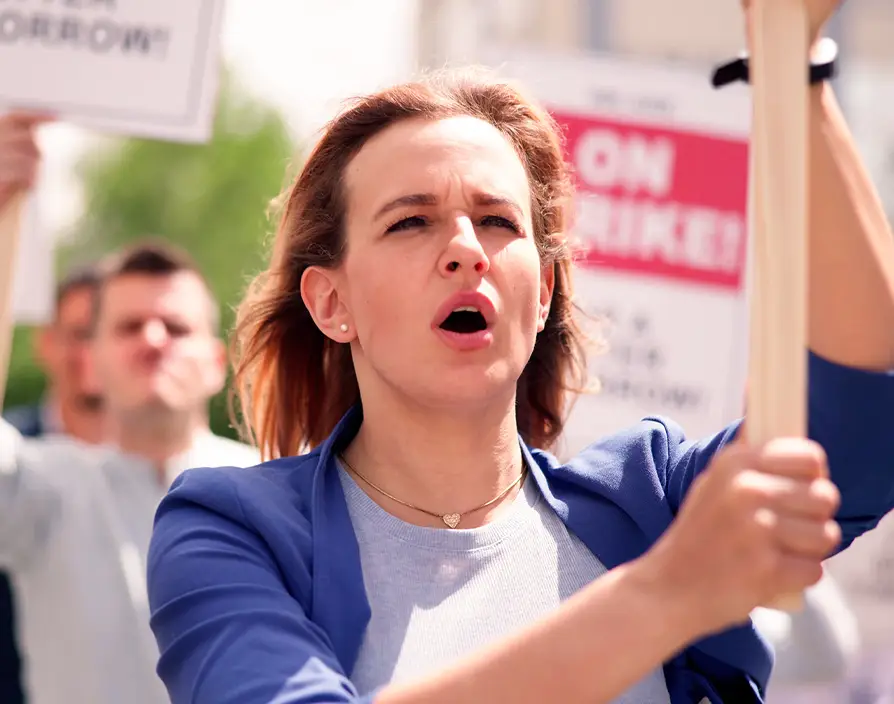
The volume of days lost to strikes has fallen from the extraordinary highs of 2022–23 where 3.54 million working days were lost to strikes, but action is more targeted, more strategic and increasingly shaped by new labour laws. For leaders, the next few months will be less about “will strikes happen?” and more about “where, and how exposed are we?”.
Where are strikes happening now?
The most visible dispute remains in the NHS. Resident doctors (formerly “junior doctors”) in England will stage yet another five-day walkout from 17–22 December 2025, the 14th strike since March 2023. The British Medical Association (BMA) argues that real-terms pay has fallen sharply since 2008 and highlights a growing crisis in training places, with highly qualified graduates failing to secure posts. The government counters that pay has already risen by close to 30% over three years and warns of mounting pressure on waiting lists and NHS finances.
NHS England estimates that industrial action since late 2022 has led to at least 1.7 million rescheduled appointments and procedures, with significant knock-on costs for productivity and patient care. While healthcare employers are in the front line, every cancelled appointment, delayed operation or extended waiting list has ripple effects for businesses whose employees are carers, patients or clinicians.
Higher education is facing its own flashpoints. Staff at institutions such as Imperial College London and the University of Derby are taking or have announced strike action over pay, redundancies and course closures, with some universities facing multi-day stoppages in early December. For employers, this matters not just because of disruption to teaching, but because it jeopardises the talent pipeline into key sectors, particularly STEM and professional services.
Industrial unrest is also visible in local government and culture. Refuse workers in Birmingham have mounted strikes amid allegations of bullying and blacklisting, prompting the council to suspend all bin collections temporarily. Staff across the Tate galleries have launched week-long action over pay, with some sites forced to close and others running skeleton services during major exhibitions. These disputes may look “local”, but they hit everything from hospitality footfall to city-centre retail.
The next wave: what’s coming over the horizon?
For businesses planning the first half of 2026, the key question is where the next flashpoints will emerge.
Health will remain volatile. Resident doctors are balloting to extend their strike mandate through to August 2026, signalling that further walkouts are likely if no pay and workforce deal is reached. Employers in pharma, med-tech, private health and adjacent sectors should plan for ongoing disruption to clinical pathways, trials and service contracts.
Transport is another risk area. Members of the RMT working for CrossCountry Trains are staging a series of Saturday walkouts in December, disrupting inter-regional services at one of the busiest times of year. More worryingly for 2026, the RMT has threatened a wider national rail strike over rising assaults on staff and declining British Transport Police presence and is preparing to ballot members if operators do not act on safety. Prolonged rail disruption affects commuting, freight, just-in-time supply chains and business travel.
Airports are not immune. Unite has already shown its willingness to target aviation, with a threatened strike by fuel supply drivers in Scotland earlier this year that could have directly hit airlines flying from Edinburgh, Glasgow and Newcastle. Although that dispute was resolved, it underlines how quickly a small, specialised group of workers can affect a whole region’s connectivity.
Education may once again move centre-stage. The National Education Union (NEU) has just agreed a new campaign on pay and funding and confirmed it will ballot teachers in February on their willingness to take strike action over “continued austerity in education”. For employers, further school closures mean renewed pressure on parents juggling childcare and work, with productivity and wellbeing implications that are now all too familiar from previous rounds of action.
Alongside these headline disputes, dozens of localised battles – from security guards at the Bank of England, to logistics depots, to local authority services, will continue to flare and resolve. Any business with complex supply chains or public-facing services should assume that at least some part of its ecosystem will be touched by industrial action.
A changing legal landscape
The strike environment over the next 12–18 months will be shaped not just by inflation and public finances, but by significant reforms to employment and trade union law.
On one side, the Strikes (Minimum Service Levels) Act 2023 gives ministers powers to require minimum levels of service in sectors such as health, education, transport and border security. Employers can, in theory, issue “work notices” compelling named staff to work during a strike in order to maintain those minimum services. In practice, implementation has been patchy and politically sensitive; during earlier train strikes, operators were often reluctant to use the new powers, wary of escalating disputes or damaging their employer brand.
On the other side, the Employment Rights Bill now moving through Parliament will significantly strengthen protections for workers taking lawful industrial action as well as reducing the ability to claim unfair dismissal from two years continued employment to six months employment. For employers, this combination means that while minimum service levels may modestly blunt the impact of some strikes, the legal risk attached to mishandling industrial disputes is increasing. Unions will likely be emboldened by stronger dismissal protections, while businesses will face greater scrutiny of how they manage picketing, work notices and negotiations.
What does all this mean for business?
From a macro perspective, the peak of the 2022–23 strike wave has passed, but the legacy is substantial. Rail strikes over an eight-month period to January 2023 are estimated to have cost the UK economy at least £1.7 billion. Recent impact assessments show that although the proportion of firms reporting disruption has fallen, a sizeable minority of businesses, especially in transport, hospitality and manufacturing, still report operational impacts from strikes.
At the firm level, the lesson is clear: industrial action is now a structural, not cyclical, risk factor. Over the next few months, leadership teams should:
- Stress-test business continuity plans against rail, healthcare and education disruption, not just lost days, but reduced capacity, staff absence and customer cancellations.
- Map exposure to public-sector labour disputes across the workforce: how many employees rely on particular rail routes, schools, or NHS services to function effectively at work?
- Review employee relations strategy in light of the new legal environment: this is not the moment for knee-jerk disciplinary responses to lawful action or to union organising.
- Invest in communication and flexibility, from hybrid working during transport disruption to compassionate policies when school or NHS strikes affect staff.
- Communicate with the Unions: the art of negotiation has been lost by most businesses but is still a firm skill of the trade union representative. The majority of unions want open and transparent talks which can help resolve the dispute. Members taking strike action do not receive pay and is a last resort within the negotiating process.
For most organisations, the real risk is not a single “big bang” national strike, but the cumulative drag of rolling, sector-specific disputes hitting staff, supply chains and customers at unpredictable moments.
The UK is entering a new phase of industrial relations: unions empowered by legal change and tight labour markets; governments constrained by fiscal realities; and businesses caught in the cross-currents. Those that thrive will be the ones that treat industrial action as a strategic risk to be understood and empathetically managed not just an irritation to be endured until the next news cycle moves on.
Share via: