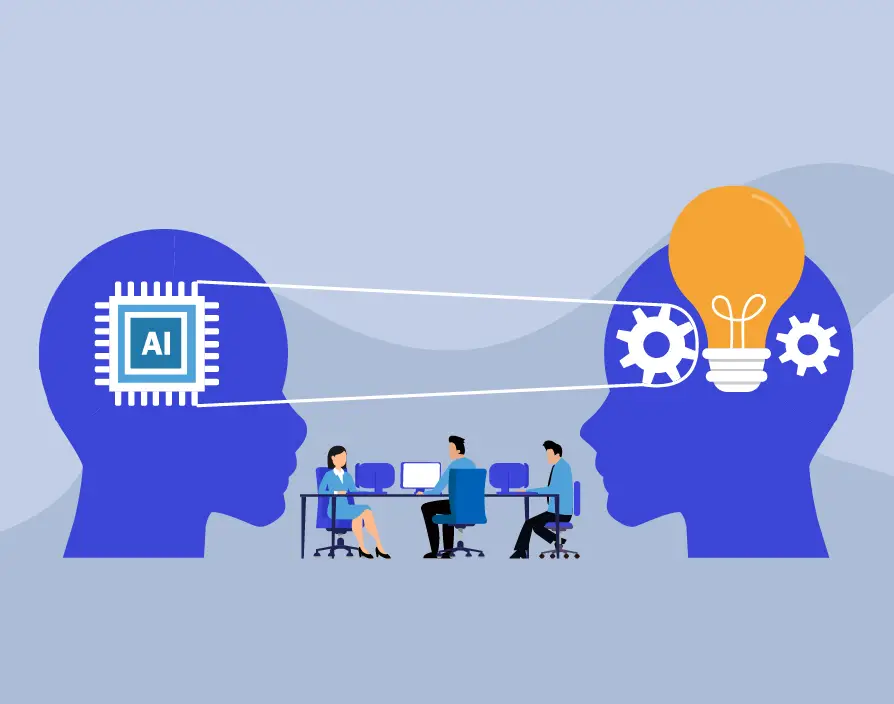
As UK companies start to embrace AI to streamline operations, improve customer experience, and drive innovation, a critical question remains: how can businesses strike the right balance between leveraging AI and making the best use of human talent?
The answer lies not in choosing one over the other, but in creating an environment where the relationship between human ingenuity and machine efficiency can complement each other. This balance is essential not only for maximising productivity and growth but also for ensuring long-term resilience and ethical responsibility.
Where AI has a future
AI undeniably offers significant advantages. From automating repetitive tasks to analysing vast datasets in seconds, AI can transform how a business operates and realise huge operational efficiencies. In sectors like finance, healthcare, and retail, AI-driven tools are already transforming decision-making processes, reducing errors, and cutting costs.
For example, UK-based fintech firms are using AI to detect fraud in real time, while retailers are setting up AI-powered chatbots to provide 24/7 customer service. These innovations free up human employees to focus on higher-value tasks, such as creative problem-solving and relationship building.
The value of human input
However, AI does have limitations and can’t replace everything a real employee brings. It lacks emotional intelligence, ethical judgment, and the nuanced understanding of context that humans possess. There are core skills such as empathy, leadership, critical thinking, and adaptability which remain uniquely human. These skills are becoming increasingly valuable as AI adoption grows.
Interestingly, research suggests that over half of UK tech businesses who replaced workers with AI regret their decision, as this change led to widespread internal confusion and employee morale which caused many other workers to leave of their own accord. Businesses should therefore resist the temptation to automate for automation’s sake and instead look to strike the right balance between where AI can really improve efficiency and where a human touch is still required.
Building a hybrid workforce
To achieve this balance, UK businesses should focus on building a hybrid workforce – one where humans and machines collaborate effortlessly. This approach requires investment in both technology and people.
First, it is imperative for companies to upskill their workforce. According to a 2024 report by the House of Commons, digital and data literacy are now essential across all industries. Employers should provide ongoing training to help staff understand and work alongside AI tools, rather than fear them. This can range from short courses to full AI-powered apprenticeship programmes.
Second, businesses should relook at roles and work processes to integrate AI in ways that enhance, rather than replace, human capabilities. For instance, in customer service, AI can handle routine queries, while human agents tackle complex or sensitive issues.
Ethical and inclusive implementation
Balancing AI and human skills also requires employers to address ethical concerns. AI systems can perpetuate biases, infringe on privacy, and make decisions without clear rationale. It’s vital that businesses adopt transparent, responsible AI practices and involve diverse voices in the design and deployment of these new technologies.
Inclusivity is equally important. The benefits of AI should be accessible to all employees, not just those who work in the technology team. This means ensuring that training and tools are tailored to different job roles so that no one is left behind as AI adoption continues at pace.
Leadership and culture matter
Ultimately, striking a correct balance relies as much on culture as it does on strategy. Leaders must champion a vision where technology empowers people, not replaces them. This involves fostering a culture of continuous learning, curiosity, and collaboration.
It also means listening to employees’ concerns and involving them in the AI journey. It is always true that when staff feel valued and supported, they are more likely to embrace change and contribute positively to innovative ideas.
Conclusion: Humans still matter
The future of UK business should not be seen as a battle between AI versus humans, rather AI with humans. By thoughtfully integrating technology with human skills, companies can unlock new levels of productivity, creativity, and growth. But this requires more than just investment in new tools; it needs a commitment to training and educating people.
As the UK seeks to become an AI superpower, it’s those businesses that strike this right balance who will survive and thrive.
Share via: