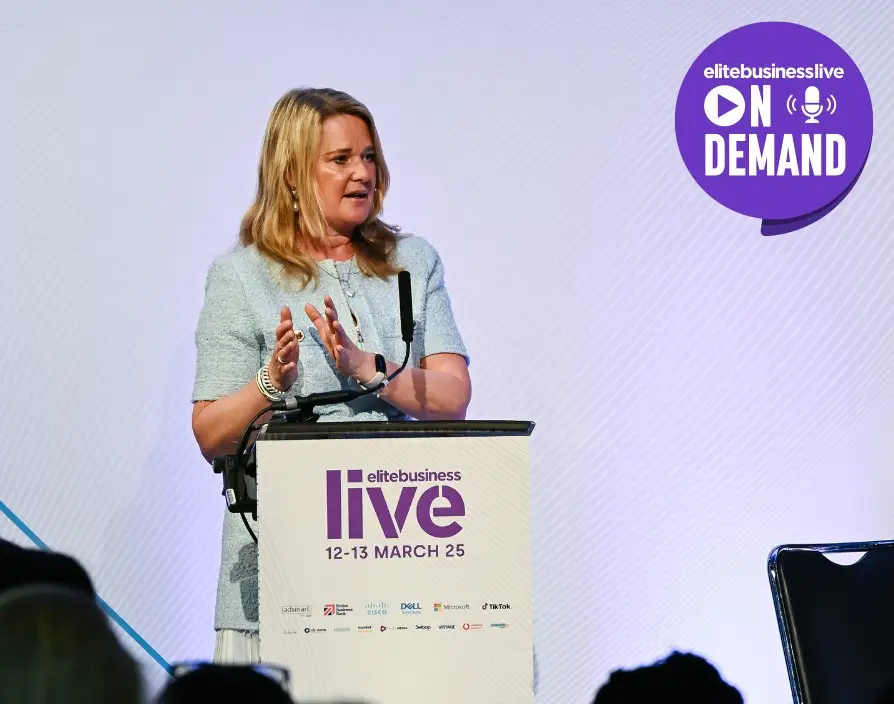
When Sam Smith stepped onto the stage at Elite Business Live, she carried the confidence of someone who had built something remarkable, and the hard-won wisdom of someone who had experience! As the founder and former Chief Executive of finnCap Group, she scaled a business from one million pounds in annual revenue to one million pounds per week over 24 years. Her keynote was not a motivational pep talk. It was a candid, deeply analytical look at what real growth looks like, and why thinking bigger is the most underused tool in business today.
Smith began with a provocative idea: there is a “doubling principle” embedded in successful business growth. It is not theory. It is a pattern she has seen again and again, from clients, from case studies, and from her own numbers. Growth is rarely linear, she explained. It is exponential, and it happens in waves. Her key message: if you want to scale, the next stage must always be a minimum of doubling your current revenue. And then, plan to double again.
The pattern behind every scalable business
Smith cited examples across industries. Online beauty retailer Cult Beauty began its scaling journey at £5.8 million in revenue, progressing to £13.6 million, then £37.6 million, £68.9 million, and eventually £123 million. Monica Vinader, the jewellery brand, followed a near-identical curve, starting at £7.6 million and then rapidly increasing to £108 million within a few years. Even Microsoft, she reminded the audience, began in 1974 with just £16,000 in revenue. Five years later, they were still under £3 million. Then the exponential growth began: £17 million, £25 million, £98 million, £200 million, and beyond.
The conclusion was clear. Businesses that scale do so with doubling as their rhythm.
Scaling and super-scaling
In her own journey, those moments were clearly defined. The decision to scale came in 2006, eight years after founding her business. At that time, finnCap was generating around £3 million in revenue. The decision to super-scale came in 2017 during a conversation with her chairman. They were walking near St Paul’s Cathedral when Smith said she felt the company had more to give. They had reached five per cent market share, and it was time to aim for ten. More than that, it was time to consider acquisitions and make a major leap forward.
What followed was an IPO, the acquisition of Cavendish, and a steep revenue climb from £24 million to £38 million to £52 million. That period, between 2017 and 2022, marked the super-scaling phase. The secret? Vision. But also the courage to let that vision grow.
The blocker you don’t know you have
Smith recounted a pivotal moment of self-realisation that helped unlock the next stage of growth. Despite all the progress, she found the company stuck around the £20 million mark. She met with a mentor, who asked, “With limitless time and limitless money, how big could this business become?” Her answer: £200 million.
That lunch changed everything. She realised she had unconsciously limited herself to a £50 million target simply because that had always been her internal benchmark. Once she lifted the ceiling, opportunities appeared that had previously felt too big. A few weeks later, they were in acquisition talks.
“Your internal goal is either your growth engine or your brake,” she said. “If you’re not seeing new opportunities, it might be because your vision isn’t big enough.”
The first £1 million is the hardest
Smith described the early years of building finnCap as slow and often frustrating. She bootstrapped the business from scratch at the age of 24, with no network, no mentors, and no outside investment. It took a full ten years to reach £3 million in revenue, but only another ten to reach £50 million. That is the nature of exponential growth. Once the model is right, it accelerates.
She explained why getting to the first million feels so difficult. “If you start at £20,000, it takes many doubling journeys to reach a million. Each step is slow and uncertain. But once you’ve found your formula, the doubling becomes faster, and the effort for each is about the same.” For her, the energy required to go from £200,000 to £400,000 was the same as going from £25 million to £50 million.
Culture and the “6 Es” of growth
Culture, Smith argued, is a crucial lever in scaling. She developed a framework called the “6 Es”:
- Excite the vision
- Enrol the team with shared ownership (including equity)
- Engage through a strong internal culture
- Elevate your star performers
- Energise your team by making the business a place people want to be
- Exit with dignity, whether that is team members who no longer fit, or you, as the founder
She encouraged founders to make business fun, to recognise talent, and to acknowledge that not everyone will stay on the journey forever, including the founder.
The 100 per cent rule
Sharing a strategic insight that transformed how she approached growth: Every scaling business should have one full-time equivalent (FTE) focused entirely on growth. That might be the founder spending half their time on strategy, with senior leaders splitting the rest. But unless someone is thinking only about growth, the day-to-day will always win.
In her own business, this shift happened when finnCap plateaued at £18–20 million in turnover. She restructured her time and her team to create that full-time growth focus, and the business broke through to the next level.
Think ten doubling journeys ahead
The final message was as bold as it was empowering. She encouraged the audience to take wherever they are right now, £20,000 or £20 million and plan to double. Then double again. And in their wildest, most unreasonable goals, imagine what ten doubling journeys would look like.
You do not need to know how you will get there. But unless you imagine it, you will not move toward it.
“I used to go back to the financials of Goldman Sachs and Rothschild and ask, ‘Where did they start?’” she said. “They all did the same three things: added new products or services, expanded into new markets or geographies, or moved into new sectors. That is how every great business grows, and yours can too.”
Closing thought
Growth is hard. It is rarely convenient. But it is also achievable if you commit to it, design for it, and think bigger than you ever thought you could.
As Sam Smith said in her closing words, “Every company started where you are. One million is the hardest. But once you’ve got there, every doubling journey gets easier.”
And with that, founders left the room thinking not about five per cent growth, but about what comes after 50 million.
Share via: