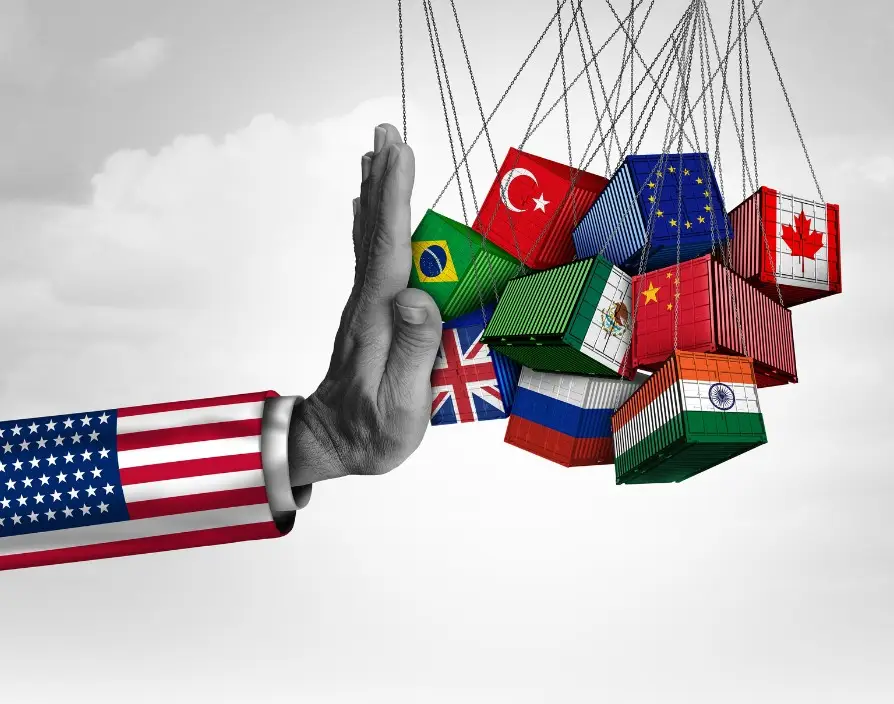
The severity of the sweeping tariffs announced by President Donald Trump on his so-called Liberation Day sent shockwaves through global equity markets. Although there is some relief that the risks of a global trade war have receded when Trump subsequently paused the most punitive reciprocal tariffs for 90 days. Despite a market rally, investors are still very nervous especially given the trade dispute with China is only intensifying. For as long as the US continues to flex its considerable economic muscle the risks to global trade have never been higher.
Whilst the EU has been granted a pause from their 20% reciprocal tariff, the negotiations will undoubtedly be difficult, a reflection of the US President’s long-held view of the blocs “unfair trading practices”. In contrast the UK faces only the Universal 10% levy. More importantly, the UK finds itself in a uniquely advantageous position as Britain seems to be “at the front of the queue” for a potential UK-US trade deal, if the government can resist the temptation to retaliate to this tariff threat. If a trade deal can be finalised imminently, the UK could emerge not only as a relative haven but as a bridge between the US and the EU, the two largest economies in the world.
Just as London is a global leader in international finance, the UK could become pivotal in global trade and gain the opportunity to redefine Britain’s role in the world.
Refuge in UK domestic equities
The immediate market reaction to the tariff threat has been understandable and immediate. Global equities, especially those exposed to international trade and particularly China have faced aggressive selloffs as capital rotates to more domestically focused sectors. Housebuilders, food retailers and utilities, perhaps considered as dull because of their UK centric businesses, now provide some insulation from geopolitical volatility. The UK has long been criticised for its lack of dynamic global technology companies but that could now be its advantage in the short term as the world reassesses valuation risk. The relative dullness of UK domestic equities is now their main attraction. An ongoing trade conflict that puts increasing pressure on globalisation could ironically be a potential turning point for how UK equities are perceived by foreign investors.
A measured response is strengthening Britain’s strategic position
The EU’s swift retaliation to the initial tariffs imposed by the US with E26bn of trade countermeasures is likely to make the negotiations over the EU’s reciprocal 20% tariffs more challenging. The UK’s more measured response could prove to be its greatest asset. While the 10% levy still presents headwinds it is noticeably less severe than the EU’s potential 20% tariff and the risk of further escalation of trade tariffs if future EU US negotiations are unsuccessful. Markets will take notice and this restraint can only improve the prospects of favourable negotiation with the American President. Ministers are already leveraging this position with Business Secretary Jonathan Reynolds continuing talks with his US counterparts and expressing confidence that the 10% tariff can be reduced. This new world of tariffs and a retreat from globalisation will mean markets will reward national resilience over global growth, and a careful, measured response may prove to be a real advantage for the UK as it presses for a full trade agreement with the US.
A long-term opportunity
The tariff threat and the associated trade uncertainty is likely to have a ’chilling’ effect on UK economic growth according to Bank of England Deputy Governor Sarah Breeden which can only add pressure to the UK’s fiscal problems. Recent OBR figures paint a worrying picture, indicating levies could reduce an already tepid growth environment by 1% by 2026/27 and potentially erode what is left of the government’s fiscal headroom. The necessity for some economic impetus for the UK economy is essential if a future fiscal crunch is to be avoided. A UK US trade deal could provide that impetus. A redefined Britain as a focus for free trade between Europe and the US and a safe and secure sanctuary in a global trade maelstrom is a tantalising prospect for foreign investment and equity allocations.
If Britain can stay above the turmoil in this global trade war and instead focus on being at the forefront of Global free trade, then this measured response could prove to be the nation’s greatest currency and potentially turn the chaos caused by Trump’s ‘America First’ agenda into the lightning rod for our countries own ‘UK exceptionalism’.
Share via: