After decades of researching business growth, the evidence is clear: fewer UK firms are scaling.
This has led me to ask the question, ‘What are leaders doing? And how can we help them break this cycle of low growth in the economy?’
The answer? While external factors play a role, we need to look more closely at ourselves and the way we lead our businesses.
Our work at the Enterprise Research Centre alongside Professor Sue Dopson of Said Business School, University of Oxford, shows a strong link between leadership capability, management practices and business performance. Understanding your leadership strengths is a critical first step in creating the environment and team needed for growth.
What type of leader are you?
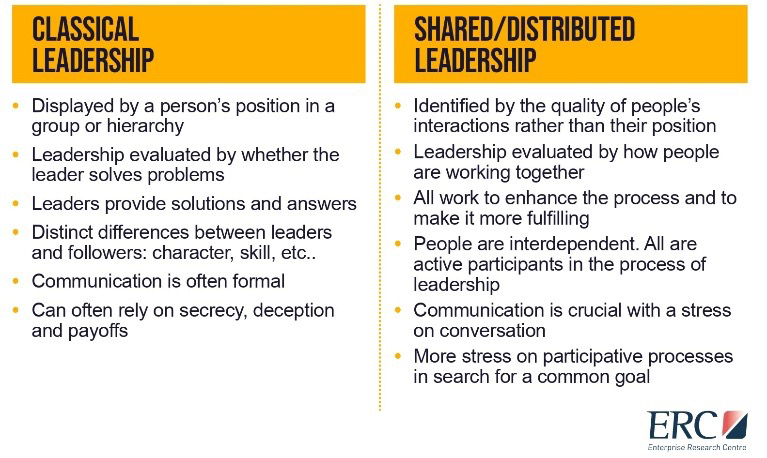
Many businesses still operate with a classical view of leadership. This model is hierarchical and transactional. The leader sits at the top, and decisions flow downwards. This approach is particularly common in long-established or family-owned businesses.
In contrast, shared or distributed leadership places far greater emphasis on collaboration, trust and problem-solving. In these organisations, authority is based on expertise rather than position. This is closely aligned with transformational leadership – a style that builds resilience by enabling organisations to adapt quickly to change.
Entrepreneurial leadership focuses on innovation, adaptability and opportunity. Entrepreneurial leaders are clear about long-term goals, but they allow flexibility in how they are pursued. Decision-making is decentralised, staff are encouraged to take risks, and learning is continuous.
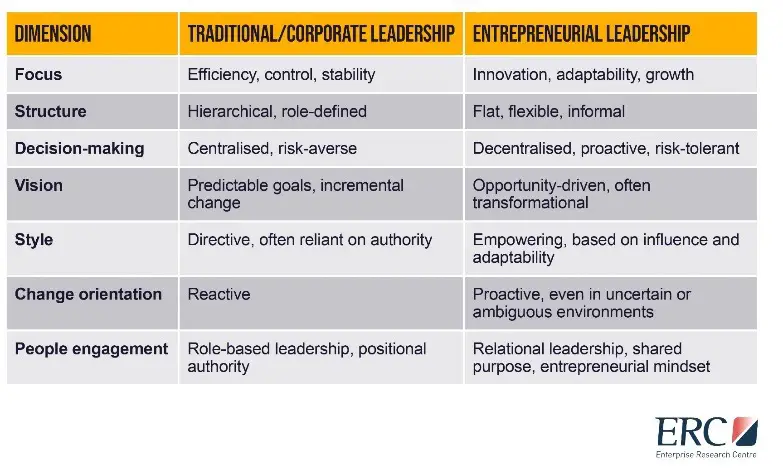
Our research has shown that entrepreneurial leadership is associated with higher productivity and improved profitability.
Developing leadership skills
So, how do we develop leaders who can take their businesses forward in this way? Together with Simon Raby, Professor of Innovation and Entrepreneurship at Mount Royal University in Calgary, I developed what we call the CORE Framework. It captures four capabilities needed for effective entrepreneurial leadership.
- Cognitive capability is how you think as a leader. It starts with foresight: your ability to see opportunities and anticipate change. It also involves critical reflection.
- Organisational adaptability focuses on how your business is structured and how it learns. Is it still built around rigid, transactional ways of working, or does it encourage experimentation and continuous improvement?
- Relational connectivity is about networks. Not just internal relationships, but connections beyond the business. Mentoring, coaching, and peer networks are among the most powerful and undervalued sources of leadership development. The real benefit of programmes like Help to Grow: Management lies in the trusted relationships they create, where leaders can share challenges and opportunities.
- Emotional resilience underpins everything else. Leadership is emotionally demanding. Resilient leaders recognise pressure and take steps to maintain their wellbeing and effectiveness.
Building and sustaining high-performing teams
Leadership capability only translates into growth when it is embedded across the organisation. High-performing teams are crucial in this. There is a consistent relationship between effective people management and turnover, productivity, and profitability.
There are four key enablers of employee engagement:
- A clear strategic narrative. People need to understand what the business is trying to achieve and how it plans to get there. This narrative must be consistent and reinforced through everyday actions and excellent communication.
- Engaging managers. Managers play a critical role in translating strategy into action. They must understand the strategic narrative themselves and help their teams see how individual objectives contribute to it.
- Employee voice. High-performing organisations listen carefully to their employees. Employees often see problems and opportunities long before senior leaders do, and ignoring this leaves them feeling disconnected. Creating effective channels for dialogue and improvement is essential.
- Organisational integrity. Values must be lived, not just stated. Consistency, fairness, and value-led behaviour at all levels build trust and commitment. When people believe in the organisation, feel respected and see opportunities to grow, they want to stay and perform at their best.
Stepping back
In summary, being an entrepreneurial leader is not about doing everything yourself. It is about surrounding yourself with the right people and creating the space to think strategically.
Finding the space to step back from day-to-day operations is difficult, but it is vital if you want to continue to grow your business.
You do not need to enrol on a formal programme like Help to Grow: Management to do this, but many people find them helpful particularly for this reason. The dedicated time to think, combined with the peer and mentoring aspects of these courses, can be the catalyst for real change.
To find out more about Help to Grow: Management, click here.