“The only thing that’s sure about a business plan is it’s definitely not going to happen.”
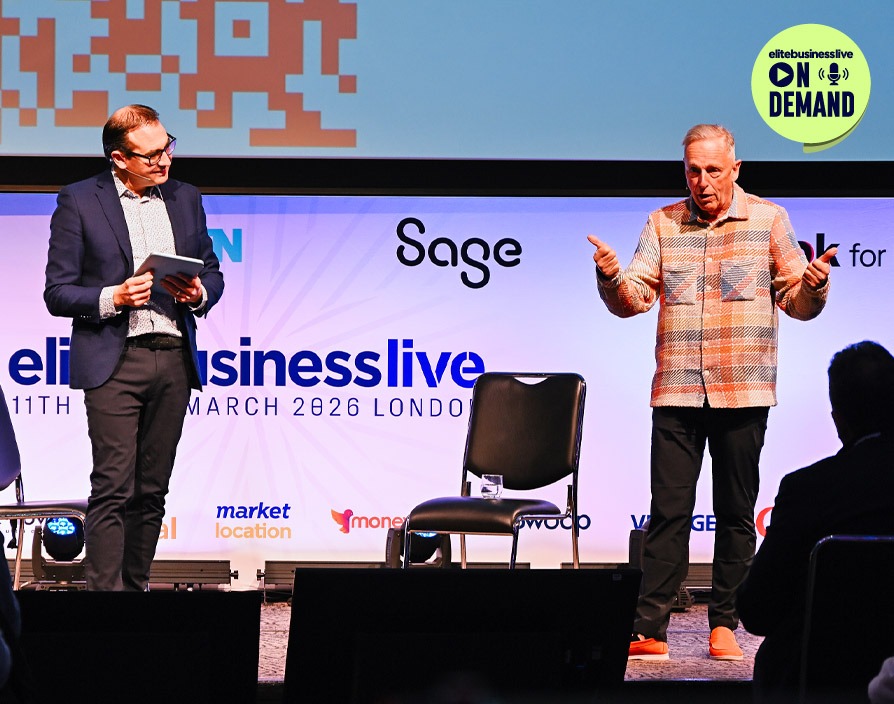
The founder of YO! Sushi!, YOTEL and the YO! Company took to the stage for an honest and often hilarious fireside chat that traced his journey from boarding school rebel and rock-and-roll roadie to one of Britain’s best-known entrepreneurs.
But beneath the entertaining stories and trademark irreverence was a clear lesson for entrepreneurs: success rarely comes from certainty. It comes from discomfort, boldness and the willingness to act before you feel ready.
“Every entrepreneur has a pebble in the oyster”
Woodroffe opened the session with a surprisingly reflective look at the experiences that shaped his entrepreneurial drive.
Raised by a senior army officer and sent to boarding school at seven, he admitted that much of his early ambition came from insecurity and a desire to prove himself.
“Every single one of us… there’s a bit of grit in the oyster that comes from what happened when you were growing up.”
It was a refreshingly vulnerable moment from a businessman often associated with confidence and showmanship. Rather than presenting entrepreneurship as a polished success story, Woodroffe framed it as something deeply personal, driven as much by self-doubt as ambition.
He described his thirties as “the hardest decade of the lot”, recalling the moment he reached 40 and realised he had “completely forgotten to become a millionaire.” That realisation became the catalyst for action.
For the Elite Business audience of founders, scale-up leaders and ambitious SMEs, it was a reminder that entrepreneurial journeys are rarely linear. Success often arrives after false starts, uncertainty and periods of reinvention.
Why discomfort is the real growth strategy
One of the strongest themes throughout the fireside chat was Woodroffe’s belief that growth only happens outside your comfort zone.
Reflecting on the creation of YO! Sushi!, he explained that successful entrepreneurs learn to tolerate uncertainty rather than retreat from it.
“If you stay outside your comfort zone for a reasonable period of time… your comfort zone gets bigger.”
It was a recurring idea throughout the session:
- Take the uncomfortable meeting
- Make the intimidating phone call
- Launch before everything feels perfect
- Accept that people may laugh at your idea before they believe in it
Woodroffe argued that too many founders wait for certainty before acting, something he believes is fundamentally impossible in business.
Instead, he encouraged entrepreneurs to embrace messiness and momentum.
“Get right out there where it’s messy. It’s got to be messy.”
For an audience navigating AI disruption, economic pressure and rapidly changing customer expectations, the message resonated strongly. Innovation rarely feels safe in the moment.
The YO! Sushi! breakthrough almost didn’t happen
Today, conveyor belt sushi feels iconic. But when Woodroffe first proposed the concept in 1990s London, almost nobody understood it.
The idea emerged during a lunch with a Japanese television executive after Woodroffe found himself “totally unemployable” and searching for his next move.
What followed was two years of obsession, visualisation and persistence. Before the internet era made research easy, Woodroffe discovered there were already thousands of conveyor belt sushi restaurants operating in Japan, but he wanted to reinvent the idea entirely.
Rather than creating a traditional sushi restaurant, he imagined something theatrical, immersive and unmistakably cool.
That entertainment-first mindset stemmed directly from his earlier career in show business, where he worked on tours with artists including the Rolling Stones and Rod Stewart. He learnt early that memorable experiences beat convention.
When the first YO! Sushi! opened on Poland Street in London, however, the response was initially underwhelming. For two weeks, almost nobody came.
Then word spread.
Soon, queues stretched down the block as curious Londoners flocked to experience something they had never seen before.
The lesson? Remarkability beats marketing budgets.
“Throw away the marketing budget. Spend all the time on doing something that’s really remarkable.”
It’s a philosophy that feels particularly relevant in today’s overcrowded digital landscape, where attention is scarce, and differentiation matters more than ever.
Simon Woodroffe’s unconventional advice on pitching
As one of the original Dragons on Dragon’s Den, Woodroffe was also asked what founders consistently get wrong when pitching investors.
His answer was unexpected.
Rather than obsessing over the perfect elevator pitch, he encouraged entrepreneurs to focus on relationships and credibility instead.
“Don’t try and get somebody to say yes. Try to get them not to say no.”
Woodroffe described what he called the “seven meeting rule”, the idea that trust and familiarity matter far more than aggressive salesmanship.
According to him, founders should:
- Build genuine relationships
- Let investors discover momentum organically
- Create external validation through press and social proof
- Focus on making the business undeniably valuable
His point was simple: investors are highly perceptive. If the opportunity is genuinely compelling, founders are not begging for investment; they are offering access to something exciting.
That subtle mindset shift drew visible nods from the audience.
“Tell me more”: the power of saying less
Among the many memorable moments from the fireside chat, perhaps the most practical advice came right at the end.
Woodroffe urged founders to stop over-explaining themselves.
“The best thing about not talking too much is you get the words you’re looking for: ‘Tell me more.’”
For a room full of entrepreneurs constantly pitching, networking and selling, it was a powerful reminder that confidence is often quieter than people think.
Listening, curiosity and authenticity matter more than performance.
It also reflected the wider tone of the conversation itself. Despite his enormous success, Woodroffe avoided presenting himself as someone with all the answers.
Instead, he shared lessons through stories, failures and personal experiences.
That honesty is perhaps what made the session so compelling.
The takeaway for founders
Simon Woodroffe’s fireside chat at Elite Business Live 2026 wasn’t a masterclass in perfect entrepreneurship. It was something far more useful: a reminder that most successful businesses begin with uncertainty, discomfort and imperfect action.
His message to founders:
- Stop waiting for perfection
- Be bold enough to make the call
- Create something remarkable
- Learn to tolerate discomfort
- Focus less on pitching and more on building trust
And above all: “The time is now, and the place is here.”
To explore more insights from industry leaders and discover additional on-demand sessions covering growth, leadership, AI, sales and entrepreneurship, visit the interviews section on Elite Business.
Sign up to livestream Elite Business Live 2027 for FREE
Share via: