We didn’t expect to be moved at a finance panel! Inspired, perhaps. Informed, certainly. But as we listened to five remarkable voices take to the stage at Elite Business Live to discuss gendered funding, what we heard was greater than just insights. It was lived experience, sharp honesty, and hard-won wisdom that turned a well-worn topic into a rallying cry for change.
Lifting the lid on the gender gap
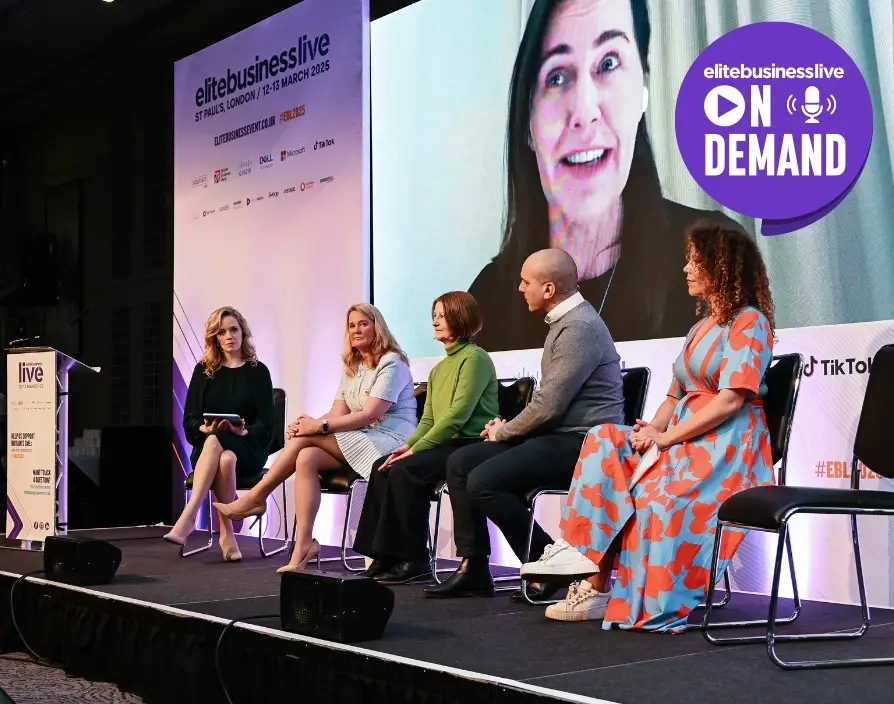
The finance panel, titled “The Untold Story of Gendered Funding”, brought together some of the most compelling voices in UK enterprise: Hattie Fawcett, founder and CEO of Focus for Business; Louise Doyle, CEO and co-founder of Needi; Andrea Reynolds, dialing in from the US fresh off a successful VC raise for her platform Swoop; and Richard Bearman from the British Business Bank. Sam Smith, the first woman to float a British stockbroking company, the session struck a rare balance of candour and constructive optimism.
The reality, raw and unfiltered
The session opened with personal truths, stories you don’t often see in pitch decks or press releases. Hattie spoke of raising funds for her business 15 years ago, facing rooms of male investors who simply didn’t understand her product or her market. The questions she was asked were markedly different from those posed to male peers: not about growth, but about risk. “I was asked how I’d stop things from going wrong, not how I’d scale success,” she recalled. Her most jarring memory? Being introduced at a pitch event as a woman who had just given birth three weeks earlier, as though her biology was more notable than her business.
Louise Doyle shared her experience of raising over £1 million for Needi while pregnant with twins, a feat made marginally more navigable thanks to the camouflage of Zoom. But it wasn’t just resilience that got her over the line; it was connection. “Both of my lead investors were women,” she explained, “and they just got it.” This idea of being understood, not just funded, became a defining thread throughout the conversation.
Reframing the numbers
Sam Smith addressed the infamous statistic: only 2% of VC funding goes to all-female founding teams. A dismal figure, yes, but perhaps not the full story. Sam urged the audience to look beyond the headline. If we include mixed-gender founding teams and female-led businesses with strong leadership teams, funding figures are improving — slowly, but surely. She pointed to promising data: £4 billion raised by female-powered businesses in the UK last year, up from less than £1 billion five years ago.
Richard Bearman echoed this cautious optimism. “Progress is there,” he said, referencing the British Business Bank’s work, where 40% of their Startup Loan recipients are women. Yet the overarching view was clear: the system still needs rewiring, not just tinkering.
The mentorship multiplier
A crucial part of the conversation was the role of mentoring, not just the formal kind, but the honest, practical, no-nonsense kind that happens in WhatsApp groups and over coffee. Sam described her Super Scalers initiative, which pairs underrepresented founders with women who’ve built businesses to £50 million and beyond. “When you can ask, ‘How did you do that?’ and get an answer in three minutes, that shortens the whole journey.”
Hattie agreed, calling mentorship “as powerful as cash” in the early stages of building a business. Perhaps even more powerful. And as for whether male mentors are welcome? Absolutely. “Why would you exclude men? They have value to offer too.”
A global perspective
Dialling in from the States, Andrea Reynolds brought an international lens to the debate. She compared the UK and US VC landscapes and didn’t sugarcoat it: “Europe is more risk-averse. Sometimes it feels like you’re going through a private equity round, not a venture one.” But she noted that female-led businesses, particularly in fintech, are increasingly in vogue in the US, driven by recent exits, capital recycling, and a growing recognition of the sustainable, capital-efficient models many women tend to build.
Her approach to funding? “Go into the room and see it as genderless. Set your mindset, and you’re already winning.”
Beyond the pitch
It would’ve been easy for this panel to feel like a closed conversation, one primarily for female founders. But the panellists challenged that too. “Why should everyone care?” the moderator asked the panel. Louise’s answer was simple: because diverse businesses change the world in diverse ways. Because when women build, they often build with purpose. And because representation isn’t a woman’s issue — it’s a business one.
Andrea added that what’s needed is a pipeline: of female founders, of female investors, of mentors, of role models. And that pipeline, she insisted, is finally beginning to flow.
Getting funded and staying resilient
The closing minutes became an advice clinic. How do you raise your first round?
- Andrea suggested starting with a startup loan and layering in SEIS or EIS capital.
- Louise championed grants and getting over the fear of sharing your idea
- Richard advised seeking the right finance at the right time.
- Hattie reminded us not to do it alone; community is everything.
- And Sam, ever the realist, concluded with this: “You’re living in the land of no. It’ll take hundreds of rejections. But you only need one yes. Keep going.”
This wasn’t just a panel. It was a mirror. A spotlight. And for many of us in the audience, a nudge to keep asking harder questions and expecting better answers.
In a world still tilting toward the familiar, the safe, and the male-dominated, this was a session that did what great journalism and great entrepreneurship share at their core: it told the truth. And it showed us what’s possible when more people get the chance to write their own story.
Share via: