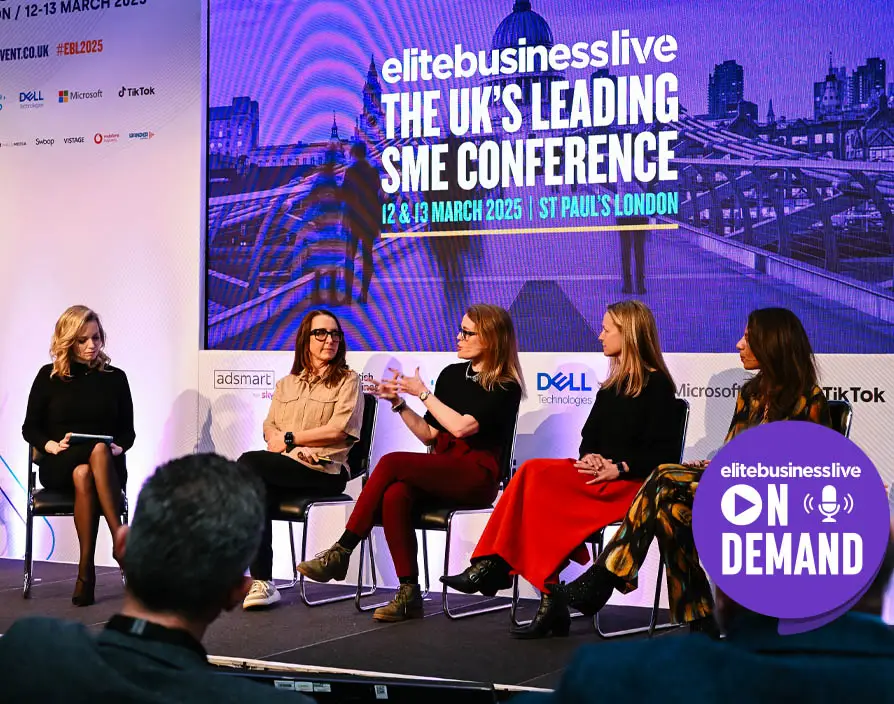
The Hybrid Hustle, a panel session that brought together Amy Hopper, Joanne Howes, Nicky Avram, and Shaa Wasmund MBE on the main stage at Elite Business Live.
Billed as a discussion on teams and talent in the new world of work, what unfolded was far more insightful: a redefinition of leadership, culture, trust, and what it really takes to thrive in a hybrid business environment. From personal trauma to professional insight, the conversation swung between deeply human experiences and practical leadership strategies, all delivered with radical honesty and humour.
Leading through adversity
The session opened on a raw note. Amy Hopper, founder of the TOA Group, shared her harrowing personal journey, recovering from spinal fusion surgery and the tragic loss of her husband, all while leading a business. It was a sobering reminder that leadership isn’t just about quarterly results or team KPIs, it’s about resilience, vulnerability, and the people behind the job titles.
“Hybrid working saved my business,” she said. “It wasn’t trendy, it was necessary. I had no choice but to trust my team.”
And trust quickly became the session’s most vital thread.
Micromanagement is the leadership crutch
Employment lawyer and leadership expert Nicky Avram wasted no time calling out the futility of top-down micromanagement, particularly in the hybrid space. “The most underutilised asset in any organisation is human potential,” she said. “You don’t unlock that by monitoring keyboard strokes or badge swipes.”
Her message? Empowerment is the job. Leaders should be custodians of growth, not controllers of time.
Joanne Howes, behavioural coach and CEO of The Change Creators, added a psychological lens to the issue. “Many leaders micromanage because they think they’re helping,” she explained. “They feel they need to rescue or fix. Real leadership is asking better questions, not giving all the answers.”
It was a moment that made me think about every boss I’ve ever had, and more than a few colleagues, too.
What type of leader are you?
When Shaa Wasmund was asked to define her leadership style, she didn’t mince words: “I’m impatient. I’m visionary. I don’t like chasing people.” Her solution? Hire adults and treat them like adults. If someone can’t be trusted to get on with their job, it’s not the work model that’s broken; it’s the hire.
But it was her next point that hit the room like a lightning bolt: “I’m worried about the 20-somethings who only want remote work. They’re missing the very relationships and networks that helped build our careers.”
As someone who started my career in a buzzing newsroom, I felt that deep in my bones. Zoom can’t replicate shared glances, spontaneous ideas, or water-cooler breakthroughs.
Where do we belong now?
The panel didn’t shy away from big players like JP Morgan or Amazon mandating office returns. Amy noted the clear disconnect between executives with EAs and the rest of us juggling childcare, commutes, and the weekly shop. “Some of these CEOs have no clue what daily life really looks like for their teams,” she said. “Empathy has to drive policy.”
Hybrid, they all agreed, isn’t about proximity, it’s about intentionality. Create spaces people want to return to. Make the commute worth it. Focus on output, not hours.
As Nicky put it: “It’s not a free-for-all. It’s about aligning people’s strengths with company goals, and giving them room to thrive.”
Trust first, not last
Joanna offered perhaps the most transformative idea of the session: “What if we stopped making people earn our trust, and gave it from the start?”
It was met with nods across the room, including mine. We talk endlessly about psychological safety in modern teams, but how often do we lead with real trust?
She added that in her own fully remote company, “connection” is cultivated deliberately, through spontaneous check-ins, playful rituals like ‘Win of the Week’, and no back-to-back Zooms. “You can absolutely build culture and community remotely, it just takes thought and care.”
Resilience, culture, and the human factor
In the final moments, an audience member asked how to help others build resilience. The answers were quietly profound.
“Resilience is a muscle,” Shaa replied. “You build it by normalising struggle, being honest about it, and walking through it together.”
Amy added, “Structure helps. Therapy helps. But so does self-awareness. Not everyone can just ‘be resilient’, we need tools, support and space.”
And isn’t that the future of work in a nutshell?
The hybrid hustle is a human one
This panel wasn’t just a highlight of the day, it was a blueprint for modern leadership. These women made it clear: hybrid isn’t about location. It’s about trust, flexibility, and a fierce commitment to people-first cultures.
If we want high-performing teams in this new world, we need leaders who are willing to unlearn, to listen, and to lead with empathy. As Shaa put it so simply: “It’s not about being perfect. It’s about being real.”
And after sitting through that conversation, we left not just inspired but also challenged to lead better.
Share via: