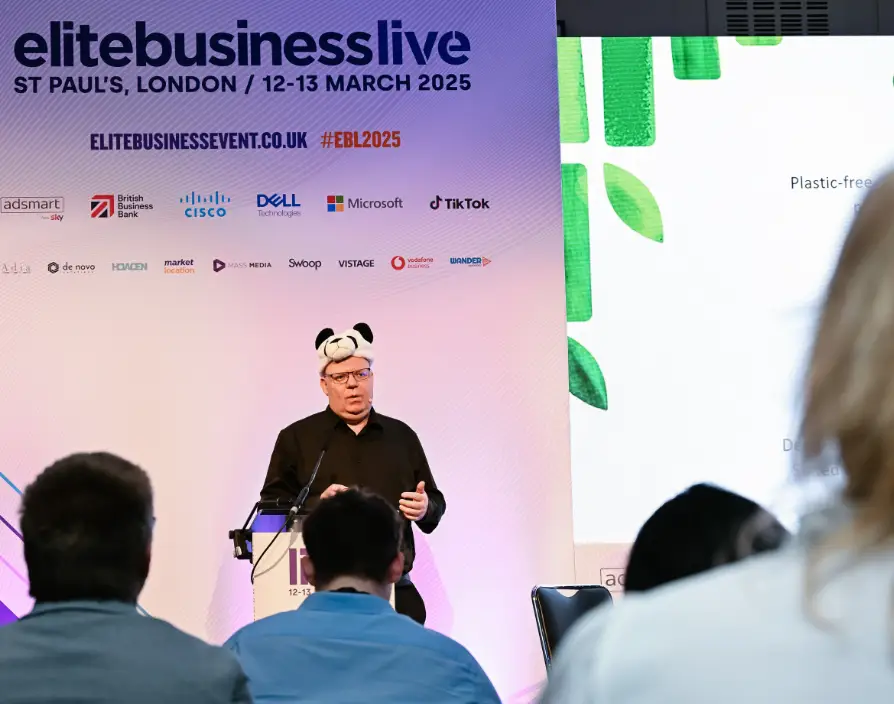
From the moment he began speaking, Chris exuded an energy that was infectious. But it wasn’t just the gimmick of the panda hat that held our attention; it was his candour, humility, and the compelling story of how Cheeky Panda, the bamboo-based household brand he co-founded with his wife Julie, went from a wild idea to a global, multi-million-pound business.
A simple idea with serious impact
“Let’s make tissue from the world’s fastest-growing plant, bamboo.” That was the spark Julie had nine years ago. Chris, like any good business partner, asked, “Is it any good?” Her answer? “It’s really good, soft and silky.” That moment lit the fuse for what would become a sustainability movement disguised as a tissue company.
Fast-forward to today, and Cheeky Panda has sold over 4.6 million units and sits proudly on the shelves of Boots, Waitrose and over 10,000 retail locations. Their products are seen not just in homes but in hotel chains, zoos, and offices across the UK. It’s more than toilet roll, it’s a statement of what business can be when it chooses purpose alongside profit.
Sustainability vs survival
Chris’s keynote, titled “Sustainability vs Survival”, tackled a common fear for founders: can you afford to be green? His answer was refreshingly honest. “You can’t do it all at once,” he said. “Pick your battles. Start somewhere. Iterate.”
They began with plastic-wrapped products because that was the only viable way into the market. Today, everything they sell is plastic-free. They chose the FSC certification as their sustainability foundation and later became one of the first 100 UK companies to achieve B Corp status. For Chris, B Corp wasn’t just a badge. It was the scaffolding upon which they built solid HR, environmental and governance practices as they grew from a team of five to 35.
“Sustainability will only win if it’s desirable,” he declared. That line stayed with me. It’s not enough to be ethical, you’ve got to be attractive. In a TikTok-fuelled, Instagram-fed world, Cheeky Panda’s vibrant branding and cheeky humour help it stand out. After all, no one shares a beige tissue pack on their story.
Bamboo: A quiet revolution
Chris made no apologies for making us rethink the humble tree. “We cut down over a million trees a year just for tissue. Trees are the lungs of the earth. That doesn’t sound very sustainable to me.” Bamboo, by contrast, grows back after harvest and maintains biodiversity. In short, it’s not anti-tree. It’s pro-choice.
And what about the critics who question the carbon footprint of manufacturing in China? Chris responded with something powerful: a video tour of their production process, from mountain bamboo forests to pulping machines powered by solar panels. It wasn’t just a corporate gloss, it was a transparent, intelligent way to maintain “one version of the truth” in a world full of diluted messaging.
From start-up to scale-up
Chris spoke with honesty about the financial realities of building a purpose-led business. “Cash is king,” he said. “Ninety per cent of UK start-ups fail not because the idea’s bad, but because they run out of money.”
For the first three years, Chris juggled Cheeky Panda with another business. Growth was deliberate. They started on marketplaces to avoid hefty retail listing fees. Only once they had the traction did they scale. And when they did, they did it smart. Distribution was everything, and still is. “If your distributors support you, you can do great things.”
Panda power and playfulness
One of the standout lessons? Never underestimate the power of standing out. “I wore the panda hat to networking events so that people would ask questions.” It worked. It sparked conversations, created buzz, and built relationships. “If 100 people are in a room, and you’re the one in the panda hat, 100 people are talking about your business.”
That same energy flows through the entire Cheeky Panda brand. From viral panda emojis to their “soft launch” of sanitary pads that sold out two containers on Amazon, Chris and his team know how to balance fun, functionality and eco-consciousness.
Words of wisdom for founders
His advice for fellow entrepreneurs?
- Play to your strengths and know your weaknesses.
- Surround yourself with people who know more than you.
- Don’t listen to your mate John just because you’ve known him for 20 years.
- Hire slow. Fire fast. Culture is everything.
- And don’t wait to be perfect, just start.
Oh, and if you’re working with family (like Chris and Julie)? Make sure you complement each other. “She’s the product genius. I’m more sales. It works.”
Small acts, big change
As Chris wrapped up, he left us with a quote that brought the entire keynote full circle:
“How can we, as one person, make an impact? We can’t. But small acts, multiplied by millions, can transform the world.”
Sitting there in the audience, I felt a quiet shift in the room. Sustainability wasn’t presented as a heavy burden or a corporate box-tick, it was framed as a creative challenge, a business advantage, and, most importantly, a movement we can all be part of.
So, yes, Chris wore a panda hat. And yes, he got a few laughs. But more than that, he left us with something rare: hope, inspiration, and a clear reminder that even in the world of loo roll, there’s room for real innovation.
Share via: